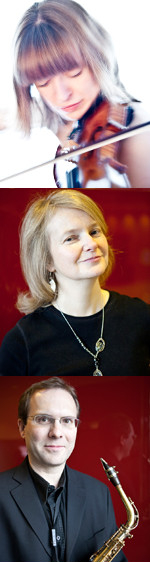

- Russell Hepplewhite talks to Barry Millington about his new work Urban Abstract
- Edward Rushton and Dagny Gioulami talk to Barry Millington about their new work Pandora, Organic Machine
- David Matthews talks to Barry Millington about his new work Actaeon
- John Casken talks to Barry Millington about his new work Deadly Pleasures
- James Francis Brown talks about his two new Wordsworth settings
- Jean Hasse talks to Barry Millington about her new score for the film Ghosts Before Breakfast
- Ross Lorraine talks to Barry Millington about his new work Not More Lovely
- Jean Hasse talks to Barry Millington about her new score for the film The Fall of the House of Usher
Russell Heppplewhite talks to Barry Millington about his new work Urban Abstract
BM: Urban Abstract was inspired, I believe, by the architecture of buildings. Could you expand on that?
RH: So often in my composing I respond to text, so to find inspiration in buildings and architecture was totally different for me. Buildings are static and fixed, and yet their shape, angles, contours and physical presence can express something non-static and moving. It was this that I sought to capture something of a paradox I guess.
BM: How do these connections find expression in the music?
RH: In the first movement of my piece its the contrast between architectural curves and angles which is explored, and certainly the music moves between being smooth and undulating to being jagged and precise. The second movement is something of a homage to beautiful buildings which have been destroyed for one reason or another. I looked at pictures from the last 100 years - from London buildings destroyed in the Blitz right through to streets of old town Beijing bulldozed to make way for the 2008 Olympics. The final movement looks at the way individual buildings make their mark on their immediate surroundings, and how they grow together with other buildings to form a city. This movement also looks forward, anticipating what is to come with excitement and perhaps a little bit of scepticism.
BM: You have referred to the functionality of much contemporary architecture, with too little regard for aesthetics. Is this a problem with contemporary music too?
RH: With a continuing world population explosion there is little choice in many countries but to build quickly. Functionality may well prove to be all-important, with little regard for aesthetic appeal in much new building design. In music, I really don't think this is the case. Most composers are still after a sort of beauty of one sort or another, and beauty comes in many different forms.
BM: Which contemporary composers have inspired you most, and in what way?
RH: John Adams because he addresses a wide audience in a personal way. Louis Andriessen because his sound is so utterly bright and immediate. Jonathan Dove because his music expresses so much without any unnecessary complication. Nancarrow because nobody else mixes up different genres quite like he did!
BM: Which composers of earlier times do you find you empathise most with?
RH: A real mix of figures here - probably not worth trying to draw too many links because these are simply composers that I keep returning to and enjoying: Purcell, Haydn, Beethoven, Poulenc, Milhaud, Weill, Holst, Janček, Sibelius, Ives...the list goes on!
BM: What were the particular challenges of writing for an ensemble such as Counterpoise?
RH: The instrumentation! Whether to highlight one instrument above the others in a particular movement or whether to give each instrument an equal role and then how best to balance the different timbres accordingly. It all comes down to the essential business of composing - what is the very best way to communicate your ideas to the listener. The ensemble becomes your voice with a line- up consisting of piano, violin, saxophone and trumpet there are myriad exciting possibilities to explore and a fair few traps to fall into also!
Edward Rushton and Dagny Gioulami talk to Barry Millington about their new work Pandora, Organic Machine
BM: How does your version of Pandora relate to the familiar myth of the girl who unwittingly releases all the evils of the world by opening her box?
DAGNY: 'The girl opening her box'? Phrasing your question with these words exactly points to the complex of the Pandora myth: the woman bringing badness through opening her body, either receiving man with her sex or giving birth. Woman perceived as bringing evil is one strong aspect of the story, at least it was one that was often retold or elaborated on, starting with Hesiod. I wasn't very interested in that. I was fascinated by the story of the woman who was created out of clay, and comes to life.
BM: Have you emphasised contemporary resonances of the story and, if so, how?
DAGNY: I tried to work on the idea of a machine that (or in this case who) gets out of control. (The title, 'Organic Machine', alludes to a machine that feels living, warm, pulsating, made of organic matter. The word makes English speakers think of food, I know; I like the word because it also has the organs in it, and somehow the decomposing of matter.) We rely on machines today, they often work in complex systems that humans cannot quickly enter, oversee, manipulate anymore. Machines are built and programmed to take decisions. Machines are not ethical though. So if something goes wrong, its not the machines or the systems fault.
BM: You have used myth in several of your works. What attracts you to these old stories?
DAGNY: Im half Greek, I grew up with these stories. It is a coincidence though that Edward and I have written quite a few music theatre pieces based on myths. Most of them were commissions, and we were asked to write something about the Odyssey, or about Pandora. Maybe the myths choose us because we like them. Who knows?
BM: There are some unusual instructions to the performers in the score. Can you say something about these?
EDWARD: I suppose you're referring to the final passage of the work where all the musicians put away their instruments and take part in the symbolic ritualised destruction of the piano. Hephaistos destroys his own machine at the end of the work I looked for a musicianly equivalent to this action, and had the musicians play out something equally unthinkable: the destruction (well, its just symbolic of course, really they just pack them away) of their instruments; musical instruments are indeed machines, but have become, as the cliché has it, 'extensions of the personality/body/soul of the musician', during the many years of love and work they have spent together. The fact that the violinist, saxophonist and trumpeter are called in to help 'destroy' the piano as well serves the purpose of enabling a few great and horrifying sounds which the pianist alone couldn't create while keeping his foot on the sustaining pedal. The final fortissimo A flat is symbolic of Hephaistos' failure to turn the clock back to a state of the world before even the idea of Pandora, or of woman, entered the world - A flat being the note that comes 'before' A, before alpha. A flat has also been symbolic of woman throughout the piece, as being the tonic of a (in my opinion) particularly beautiful and sensual tonality (I'm also childishly fond of the A flat = 'As' pun), and the pianist's crushing fist blow on the piano's central A flat is an attempt to smash it to smithereens, which fails a) because he's got the soft pedal down and b) because he doesn't obliterate the note so much as the very opposite: sound it. It's there, as sound, as object, in existence, in the world, irrevocably. Another unusual instruction in the score perhaps worth mentioning is the cluster of the entire keyboard, white and black notes, which required the construction of a special two-tiered stick that the pianist applies to the keyboard at the beginning of the third part. All the keys at once not only sounds great, but is also symbolic of the all-encompassing, all-gifted, all-giving Pandora. It's a 'pan'-music and I was only able to go one better by bringing in the 'unmusical', third-party inflicted crashes of the piano's 'destruction' already described.
BM: The work also exists in a version for baritone and piano. How does this differ from the version for narrator and ensemble? And what are the specific challenges of writing a part for speaker?
EDWARD: The version for baritone and piano is of course much longer, since the sung word takes much more time than the spoken, as a rule. Other than that, it's the pianist's challenge to play the work with as many of the weird colours possible in the violin, saxophone and trumpet version, as well as the singer's job to corporealise Hephaistos convincingly within the restrictions provided by the written-out vocal line - maybe this is easier for an actor without such a specific authorially-controlled text - but on the other hand, maybe not. As it is, I simply let the speaker speak more or less according to his own taste, within a relatively free time-framework.
BM: You've written a number of operas now. How do the two melodramas you have written for Counterpoise, On the Edge and Pandora, relate to these, or do you regard melodrama as a completely different genre?
EDWARD: I certainly see them as related, partly by the sort of mythological subject-matter some of them share, partly by the fact that they belong to the group of works that attempts to form an entertaining and plausible work of art by combining various different media: in the case of Pandora, words, music and dance; in the case of On the Edge, words, music and video; in the case of the operas, words, music, drama and the many parts of staging.
David Matthews talks to Barry Millington about his new work Actaeon
Alternative content
John Casken talks to Barry Millington about his new work Deadly Pleasures
BM: How did you approach the characterisation of the three suitors?
JC: It seemed obvious to me to take advantage of the three 'solo' instruments in the ensemble. So, Flavius, the old soldier, had to be introduced by the solo trumpet with a bit of a military flair to it. Kriton, the young and rather bashful musician, is introduced by the solo violin in a reflective sort of way and this music haunts his particular scene. The nameless young man is characterised by the soprano saxophone: energetic and a little bit flashy. In the main sections when the men are with Cleopatra, their individual introductory music is used and developed so that it's still present, if only in the background. Flavius's scene also uses the tenor saxophone for its more earthy sound, and his vulnerability is echoed by a rocking lullaby-type music. The nameless young man has the most sustained fast music.
BM: Were there any particular challenges in writing for an ensemble consisting of violin, trumpet, saxophone and piano?
JC: Very much so. It's not a very balanced ensemble in terms of the carrying power of different instruments. For example, a violin at its loudest will never be as strong as a trumpet playing very loud. And, if the piano, saxophone and trumpet play loud, the violin can be swamped. On the other hand it can also lend an edge that can benefit unison tuttis, which is the way the work starts. All the instruments apart from the piano are melody instruments and the piano is the only instrument that can provide a real bass.
BM: In what ways is writing for a spoken narrator different from writing a part to be sung?
JC: This is the first time I've attempted it apart from in my opera Golem. When you're writing for a singer, you are in control of exactly where the words are placed in the bar and how much music each word needs. With a narrator, who may or may not read music, you have to decide where you want the different passages of text to begin and then do it in such a way that there is plenty of freedom for a natural and dramatic spoken delivery, unconstrained by the music and with clear points of coordination at the end of the passage. But, there are also two sections where I've asked the narrator to speak in the same rhythms as the piano for an exaggerated effect. And of course a spoken voice is quieter than a sung voice so I wrote the thing knowing that some discreet amplification would be used.
BM: Is the genre a significant departure in your oeuvre?
JC: As I've said, I did a bit of this in Golem, but a whole melodrama is a new departure. Whether it's a significant departure, only time will tell.
BM: Have you consciously either drawn on or avoided well-known works in the melodrama tradition, for example Strauss's Enoch Arden or Stravinsky's Soldier's Tale?
JC: I thought a little bit about the Stravinsky, especially with regard to its unique ensemble, but in general I preferred not to look at other examples.
BM: Do you regard your work as a narrated text with musical accompaniment, or are the vocal and instrumental parts of equal importance?
JC: The music and narrated text are of equal importance. The music is absolutely not a mere accompaniment or background. Sometimes, it has to try to capture something of the mood and at other times it mirrors events in the drama. But, I didn't want to slavishly echo every little dramatic turn with a musical gesture. That would have turned it into pantomime. No, the music is more organic than that.
BM: What sort of image of Cleopatra do you think emerges from the Pushkin tale as translated and completed by D. M. Thomas?
JC: Well, she doesn't seem to have been a very easy person. We know that she was very powerful, and men found her irresistible. From Pushkin and D.M. Thomas I think I felt that she was the sort of person who enjoyed playing dangerous games and would pursue her own selfish pleasure at the expense of others. There are those kinds of people around today, both men and women. But of course, the men needn't have stepped forward to accept her challenge: that is where the male sex declares its weakness and its foolishness. D.M. Thomas's text doesn't spare us any details about the sexual encounters, but Cleopatra comes across as a woman with a fierce sexual appetite, though someone who is also patient (with Kriton), and when she recognises that the nameless young man may be her son, she is rather reckless. The suggestion is that she wanted to exert her power over him, come what may, but also 'struck by sudden terror/Of slow decline', it's a way of reminding her of the beauty she possessed when she was young.
BM: Do you find the text sexist in any sense, and if so, have you tried to confront that aspect?
JC: I'm not sure I'd use the word sexist, but there are aspects that I'm not entirely easy with, especially in the way that Cleopatra's no longer youthful body is held up to scrutiny. Also, the details of sex in the outer scenes are described in such a way that, for obvious reasons in this dramatic scenario, have nothing to do with love, and everything to do with what is regarded as possible and available when a woman is shown to play a leading role in such an encounter. Powerful woman offers her favours, and stupid men fall for it: yes, I suppose it might be described as a sexist scenario, and it isn't helped by the young man winning at the end.
But, at the same time, it's a dramatic artifice dwelling on selfishness, foolishness and tragedy. I could easily have used a text with a male protagonist in which these three aspects form the backbone, and there are plenty of dramas that dwell on this with a powerful man abusing his power. Would that be sexist?
BM: Was there any particular reason for renaming the story, Egyptian Nights in the original, as Deadly Pleasures
JC: The pleasures offered and accepted result in death: it seemed to me that Deadly Pleasures was a far more potent title that Egyptian Nights because it actually tells you more of what is about to unfold.
James Francis Brown talks about his two new Wordsworth settings
There was an uncanny rightness about the prospect of setting Wordsworth's poetry for the Ulverston Festival because I have long been a passionate enthusiast for the so-called Lakeland Poets. For over thirty years as a frequent visitor to the region I have walked the fells and soaked up the poetry with which they are associated. In fact, I'm currently planning a theatre work based on Coleridge's Christabel, having spent a week at Greta Hall in the very room in which this fascinating poem was completed.
I have set two of Wordsworth's sonnets for this year's festival ' Scorn not the Sonnet and Weak is the Will of Man ' and this is the first time I have used a narrator instead of a singer. The involvement of an actor brings a highly-charged spirit and clarity of communication despite the fact that a sonnet is more a vehicle for private, even abstract thought rather than narrative drama. I found this to be an exciting way of presenting Wordsworth's wonderfully crystalline mode of expression.
There's plenty of scope for melody, whether behind the spoken voice or in transitions between sections of the poetry; indeed Scorn not the Sonnet provides much musical imagery which is ideally suited to the ensemble Counterpoise with its unusual line-up of violin, trumpet, saxophone and piano.
My settings are concise; one cannot stretch a sonnet too far without doing violence to such a carefully balanced form, but I hope they will convey the sense of a larger underlying statement. Although these particular sonnets are not descriptive of the region, Wordsworth's distinctive voice is eloquent of an unfettered mind - a mind liberated by the freedom of the hills.
Unsurprisingly perhaps, I feel a close relation to certain English composers. Much English music is condescendingly described as pastoral and parochial but the best is far from sentimental or restricted and is powerful as abstract music in its own right.
Jean Hasse talks to Barry Millington about her new score for the film Ghosts Before Breakfast
BM: People react very differently to Hans Richter's film. Some see it as comic, others as sinister with violent undertones. How do you regard it?
JH: Many artists working within the cultural movement of Dada attempted to provoke and ridicule much of what was going on around them, commenting on how the modern world was changing. For me, the Ghosts film is a mixture of creative silliness and some (timid) violence, but it is also compelling. I would like to know what the artists were thinking about as they made the film and also wish I could hear the score that Paul Hindemith composed for it. Was it random or careful and planned? I suspect it was a nonsensical mixture of sounds.
BM: Was your intention to produce aural equivalents of objects in the film, or a more general soundtrack that attempted to capture the style and sound of the film?
JH: People often have only one chance to hear a new piece of music (performed live) or see a film. I thought I would try to organise the film into sections by using certain sound worlds for various scenes. I wanted the pitches to be a little quirky but also vaguely interesting on a first hearing. There are sections of sounds, melodies and riffs. In some cases, gentle music was written to accompany photographs of guns, so there is also an attempt to occasionally contradict the visuals.
BM: Was there a particular challenge in synchronising the images and the music? How is the synchronisation between instrumentalists and film effected?
JH: There was a challenge in that we have no click-track to keep the players aligned in tempo with the moving film as they play live. I have included numerous visual cues on the full ensemble score (e.g. Clock appears, Duck, Window), as an aid. For the most part, the pianist (who can see the screen) is in control of the tempi and moving the group from one section to another. In advance of rehearsals, I also prepared a sample audio score synched to the film (using computer music software), so the players could hear basically how the music worked with the film and get a sense of ideal tempi.
BM: Both Hindemith and Milhaud feature in the film, and Hindemith, as you say, wrote the original score for it, now lost. Did the association of these composers with the film affect your own score in any way?
JH: I thought it wouldn't make sense to imagine what they might have created as a score to the film or even to consider what I know of their composition work - and I had little information on their involvement with the film. Instead I focused on the images, the structure of the film, and creating a sound world that would be somewhat peculiar but also satisfying. I was also constantly thinking about the different sound qualities of the four instruments.
BM: You also improvise live accompaniments to silent film. How do you prepare for those performances?
JH: I study each film carefully and consider the structure, various scenes and the different characters. Sometimes ideas for music come during initial viewings - and I take notes. Often I watch a film and improvise until I find sounds that seem to relate to the images and mood. For most films I usually work from beginning to end, since it seems to make the eventual score as organic (to my ears) as possible. I play, notate, listen and hope I'm satisfied. Then I try to hear something in my mind for the next section, notate that and go forward.
With live accompaniment there is always a fair amount of improvisation as well, since playing live requires watching the film as it progresses, not glued to a music score. If I have time in advance I come up with a general idea of what I want to play for certain scenes and then improvise on these ideas.
BM: What else are you working on at the moment?
JH: Composing to various silent and other film scores, some teaching, some transcription and music notation projects, and working on ideas for soundscape pieces.
Ross Lorraine talks to Barry Millington about his new work Not More Lovely
BM: Can you briefly outline for us the Edgar Allan Poe story, The Oval Portrait, on which your work is based?
RL: A wounded traveller takes refuge in a gloomily gothic abandoned chateau in the Apennines. In the turret room where he intends to sleep, he finds wonderfully life-like paintings, and a book describing them. One painting in particular enthrals him - a vivid portrait of a young woman. The text used for my piece is the account he reads of this portrait's creation: a lovely and light-hearted young girl marries a painter, who, obsessed both by his wife and by his own genius, locks her up in a turret room for many weeks to capture her beauty in a painting. In his compulsive desire to achieve perfection he fails to notice that she is fading away, and as his painting is finally completed, she dies.
BM: Where did your own title come from?
RL: In keeping with the obsessive nature of the subject matter, Poe repeats several words and phrases in his 'story within a story'. One of these is his description of the artist's wife as 'a maiden of rarest beauty, and not more lovely than full of glee'. I extracted the phrase, which seemed (in a rather Beckett-like way) to sum up the piece.
BM: What particular aspects of the Poe struck you: the artist's fatal obsession with his work, his failure to distinguish between art and reality?
RL:I had previously composed a one-act opera called The Birth-Mark, based on a Nathaniel Hawthorne short story with a very similar theme, written within a year or two of the Poe. Both deal with the destructive potential of blindly seeking for an ideal of perfection that can never live in the real world. In both cases this dangerous and destructive ideal is projected onto the protagonist's wife, who is sacrificed in the process.
BM: How does your work engage with the claustrophobic world of the Poe story?
RL: I've used a technique rather like an obsessive and extreme form of serialism - two interlocked scales are used to create a 3-bar grid of pitches that is simply repeated mechanically, with no harmonies other than those resulting from held notes. It encapsulates the idea of a forced and sterile pursuance of perfection, although the actual surface of the music is playful, quasi-tonal and a little ironic.
BM: Was it a challenge placing a spoken text side by side with the music? Do you use the complete text?
RL: I do use the complete text, and in a fairly conventional way, cued by elements of the music. This was partly to enable the story to be clearly understood. Whether or not it works remains to be seen!
BM: Was the instrumentation we specified a help or a hindrance in creating your work?
RL: I like the instrumentation, because the unusual combination almost seems like an orchestra in miniature (strings, wind, brass and percussion!) Because the music has no true counterpoint, the question of balance was never a problem - in effect I am simply colouring the same theme in different ways throughout the piece.
Jean Hasse talks to Barry Millington about her new score for the film The Fall of the House of Usher
BM: The Watson and Webber film, to which you have written the score, is quite unlike the Poe story. How important do you think it is to establish a narrative?
JH: I try to find ways of implying a narrative in this film because like most films it does have a story, though much of what we see doesn't particularly make sense.
BM: Do you try to reflect or imitate the various events or images in the film in musical terms? If so, how?
JH: In a few places, such as when doorbells are rung and hammers are hit or dropped, I'm trying to be nearly diagetic with the overlap of music and visuals. Elsewhere, I hope the music enhances the scenes, giving more dramatic and emotional impact. As for how I do this musically, there is a variation of instrumentation and music styles for different scenes; the contrasts and/or similarities in sound then act as a sort of guide for and interpretation of the narrative. Often I use the violin to represent the woman in the film.
BM: There are some interesting filmic techniques in Watson and Webber's Usher, e.g. superimposition, the visualisation of words from Poe's narrative ('Beat', 'Crack', etc), optical distortions, unusual architectural angles, dramatic lighting and multiple exposure. Have you tried to reflect these in the music in any way?
JH: The shots of what seem to be floating caskets are accompanied by free-form music, a bed of sound, which might imply something 'other-worldly'. The two sequences with overlapping staircases use a changing, falling pattern of wide-spread intervals such as major and minor 9ths in the piano; the music, while moving, doesn't go very far. Other references to specific filmic techniques are only hinted at by various sound areas created for specific scenes.
BM: How have you contrived to synchronise the visual images with the musical gestures?
JH: This is the tricky thing with a live performance and no conductor. As with performances of Ghosts Before Breakfast, only the pianist and violinist can see the screen. The pianist acts as the main leader, setting tempi and sometimes cueing the others, but the violinist also uses the screen images to guide her pace in certain sections. The players follow a complete score, rather than separate parts, so they always know where they are and how they're working together and visual cues in the film are notated in bold as a guide. The final few bars of some sections can be repeated or held if players have arrived in advance of the next scene.